Use Swiss keyboard shortcuts for line commenting in Sonic Pi
Every now and then after a day at work I enjoy toying around with Sonic Pi, an amazing application for making music with code.
There are a lot of great talks by Sam Aaron the creator of Sonic Pi on Youtube but I like this one quite a bit.
So while I was sitting there with my glass of Port working through the Sonic Pi Tutorial I had the urge to gain back my text editing fluency I'm used to from my day job. Luckily Sonic Pi supports a lot of keyboard shortcuts however as of now they're optimised for a keyboard layout of the english language.
After a bit of tinkering and the help of Karabiner-Elements I managed to re-map my line-commenting shortcut of CMD+Shift+7 (I'm working on a MacBook with a Swiss German keyboard) to the shortcut defined by Sonic Pi M-/.
The configuration you'll want is:
{
  "title": "Remap CH comment combo to EN comment combo",
  "rules": [
    {
      "description": "Remap CH comment combo to EN comment combo",
      "manipulators": [
        {
          "conditions": [
            {
              "bundle_identifiers": [
                "net\\.sonic\\-pi\\.app"
              ],
              "type": "frontmost_application_if"
            }
          ],
          "from": {
            "key_code": "7",
            "modifiers": {
              "mandatory": [
                "left_command",
                "left_shift"
              ]
            }
          },
          "to": {
            "key_code": "keypad_slash",
            "modifiers": [
              "left_command"
            ]
          },
          "type": "basic"
        }
      ]
    }
  ]
}
If you also got this need then following these steps should set you up.
- Install Karabiner-Elements
- In your terminal go to
~/.config/karabiner/assets/complex_modifications - In there create a file
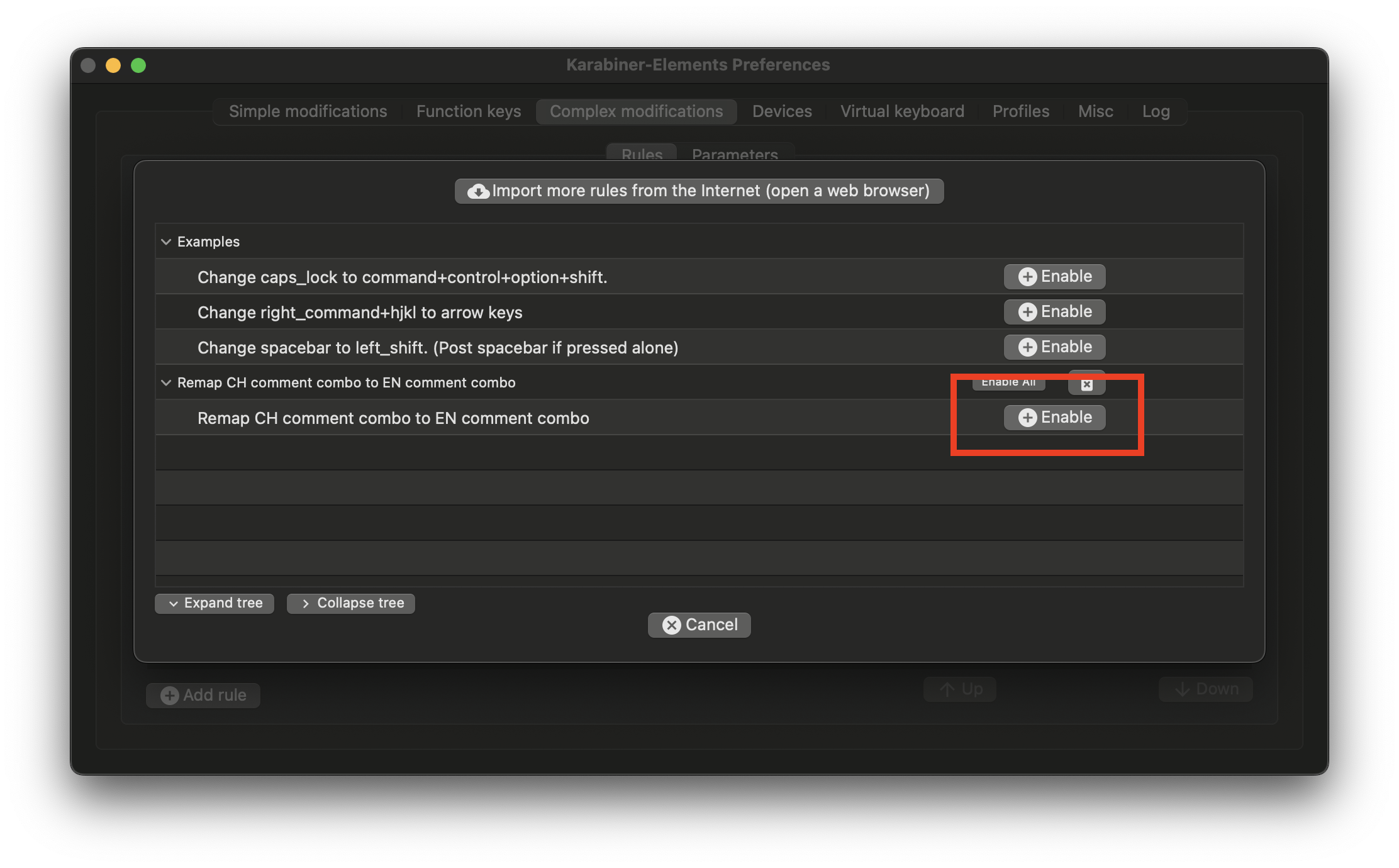
remap_ch_comment_combo_to_en_comment_combo.jsonand fill it with the configuration above. - Then start Karabiner Elements, go to the Complex Modifications tab
 and there click the Enable button for the new configuration
  .
.
Published: 2022-07-14
Tagged: Karabiner-Elements Sonic Pi